
***TWO BIG ANNOUNCEMENTS***
***I am interrupting the final couple of essays in my series on marriage to share with you some very BIG news on things that my team and I have been working on at Clemson University. I am delighted to make the following two announcements.
First, the Clemson University Board of Trustees approved this past April the creation of a new academic department at Clemson that shall be known simply and solely as The Lyceum (see mission statement below).
Second, the CU Board of Trustees also approved two weeks ago the creation of new academic center at Clemson that is named the Clemson Center for the Study of the American Founding. (I will have something to say about the new “founding” center in a couple of weeks).
Both the new department and the “founding” center will be under the purview of the Snow Institute for the Study of Capitalism.
The ossified system of higher education as we have known it in the decades since the end of the Second World War is imploding. Creative destruction is coming to higher education and from the ashes . . . may I present . . .
THE LYCEUM:
MISSION STATEMENT
Sapere Aude—“Dare to know”
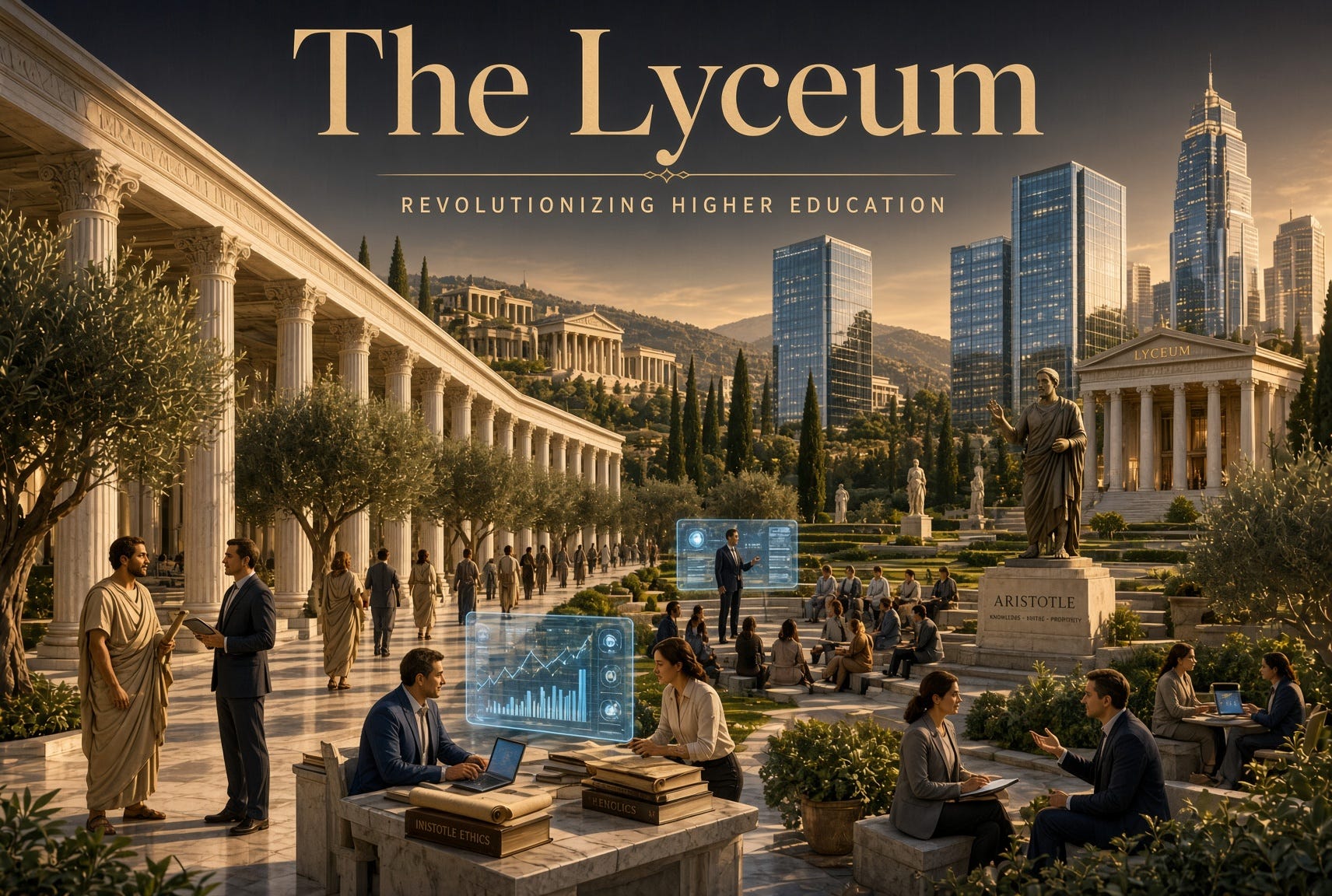
The Lyceum at Clemson University—inspired by Aristotle’s fourth-century school in Athens—is a new kind of academic department that seeks to revive the original vision and purpose of higher education: to inspire young men and women to pursue intellectual and moral excellence through a rigorous engagement with the great philosophic, historical, literary, and economic texts of Western civilization. To that end, The Lyceum is an academic community devoted to reason, objectivity, truth-seeking, the ascent to wisdom, character formation, and the perpetuation of a free and virtuous society.
Faculty and students in The Lyceum shall be guided by six pedagogic directives. First, the pursuit of Truth is our highest responsibility. Second, the discovery of fundamental truths about the most important human questions is both possible and necessary. Third, reason and objectivity are the means of discovering fundamental truths about the human condition. Fourth, knowledge and wisdom are cumulative and can be transmitted from one generation to another. Fifth, living in accord with true moral and political principles is a requirement of human flourishing. Sixth, truth, wisdom, knowledge, and moral virtue are necessary preconditions for citizenship in a free society.
The Lyceum seeks to foster a new kind of education that is not simply contemplative but that reconciles theory and practice in the daily lives of our faculty and students. At The Lyceum, we accept Francis Bacon’s aphorism, “Knowledge is power,” and we assist our students in applying that knowledge to their private and public lives. Knowledge can, of course, be used for good or evil, but at The Lyceum our students are instructed in those moral and political truths that point them toward good and honorable lives. Ultimately, our goal is to teach our students how to think in principles and how to act on principle, so that they can fulfill their greatest potential and achieve their highest aspirations.
The Lyceum Approach
The Lyceum uses a Great Books approach to studying the history of liberty, capitalism, the American founding, and the principles of moral character. Faculty and students join a 2,500-year-old conversation (and sometimes a battle of ideas) that has defined Western civilization by reading, debating, and wrestling with the deepest and most influential thinkers of the Western tradition as well as the statesmen of the American political tradition.
Faculty and students should think of The Lyceum as a place where they can explore the greatest intellectual, scientific, political, economic, and artistic accomplishments of Western civilization and beyond. In The Lyceum, faculty and students shall examine together the relationship between ideas and actions; the requirements of character formation; the history of human accomplishment; the political and cultural architecture of free societies; and the economic principles and institutions that foster wealth creation and human flourishing.
The Lyceum also understands that there is an intimate relationship between education and citizenship. All forms of education result in the formation of a certain kind of human being and citizen. The Lyceum educates its students to be self-owning, self-governing, and self-reliant citizens of a free and virtuous society—citizens who have the motivation and ability to defend the principles and institutions of their society. This kind of principled patriotism represents a return to, and the completion of, the founders’ understanding of the relationship between education and citizenship.
Whereas the modern academy has fragmented knowledge into narrow disciplinary silos, The Lyceum is intellectually capacious in its approach to teaching and learning. It integrates philosophy, politics, literature, economics, history, and ethics through the canon of Great Books and the enduring questions that have shaped Western civilization and the American experiment in self-government. More particularly, The Lyceum approach is driven first and foremost by the great questions that have animated all civilizations, such as:
What is truth?
What is wisdom?
What is knowledge?
What is justice?
What is virtue?
What is honor?
What is freedom?
What is tyranny?
What is friendship?
What is love?
What is grief?
What is happiness?
What is death?
The Lyceum approach does not, however, mean the endless—and ultimately nihilistic—pursuit of questioning for its own sake. The true philosophic way of life recognizes that reality is knowable; that the human mind is capable of discovering the truth about the most important questions; that it is both possible and necessary to live according to true moral principles; that a life of accomplishment and honor is open to all men and women; that the pursuit of happiness and a fully human life are possible only in a free society; and that the free society must be defended from its enemies.
The Lyceum is therefore reconceptualizing what it means to think, teach, and learn. Our department shall be a community of scholars in which faculty and students work together to create a close-knit “small college” experience inside a larger university. Professors and students in The Lyceum will set off together on an intellectual journey in pursuit of truth and knowledge through the close reading of core texts, Socratic-style discussion, and careful writing.
The department insists on the close, careful, and repeated reading of classic texts along with frequent and rigorous writing assignments. We also seek to foster certain habits of mind—curiosity and logical thinking, intellectual humility and courage, and clarity and precision—that equip students to think wisely, deeply, and independently in an age of ideological and emotive conformity. In so doing, we hope to liberate and elevate the minds of our students and to deepen the meaning of their lives.
The Importance of Teaching Above “Scholarship”
The Lyceum is also reconceptualizing what it means to be a professor and teacher in higher education. We seek to recover the forgotten art of classical teaching, which places teaching and mentorship above “scholarship.” In fact, The Lyceum regards much of what is today considered academic “scholarship” to be a form of trivial pursuit with little or no value for students, taxpayers, or the general public.
The Lyceum is committed to the restoration of teaching as a high intellectual and moral responsibility—one centered on the formation of free minds rather than the mere transfer, absorption, and recitation of information. Faculty in The Lyceum are chosen not merely for specialized academic expertise and research but for their capacity to engage their students in the world of ideas and to serve as models of moral and civic virtue.
In reclaiming the lost art of Socratic instruction, The Lyceum embraces and elevates undergraduate teaching and mentoring above research and publication. Teaching, rightly understood, is the noble vocation of awakening young minds to the permanent questions of human life, equipping them with the intellectual virtues necessary for living as citizens of a free society, and inspiring them to pursue truth and excellence wherever it leads.
By restoring teaching to its rightful place at the center of its mission, The Lyceum aspires to produce teachers and students who shall set off on life’s journey in the pursuit of truth, wisdom, virtue, and excellence in all they do.
While teaching and tutoring come first at The Lyceum, we do encourage our faculty to read, think, research, write, and publish, but we have a much more capacious understanding of what is known as academic “scholarship.” To whatever extent faculty in The Lyceum shall engage in research, writing, and publishing, we will support their efforts in the hope that they will write on topics that engage with and deepen our understanding of the great questions and debates animating Western civilization. Our greatest hope is that our faculty will have the capacity to impact and improve the lives of their students and fellow citizens. Otherwise, what is the point?
The Socratic Tutoring Program
At the heart of The Lyceum is our innovative and transformative “Socratic Tutor” program. Each semester, Lyceum Scholars will be assigned a “Socratic Tutor” (a faculty member of The Lyceum), who will meet individually with each of his or her tutees every other week for approximately one hour.
The purpose of the Socratic Tutor program is twofold: first, to help our students translate the true theories and principles of the philosophic texts they are reading into their lives here and now; and second, to help our young men and women think seriously and deeply—possibly for the first time in their lives—about the question of moral character, and about their own moral characters in particular.
Following in the tradition of America’s Founding Fathers, The Lyceum takes seriously the notion that there is an intimate connection between moral virtue and a free society. As John Adams once said, “Public virtue cannot exist in a Nation without private Virtue, and public Virtue is the only Foundation of Republics.” A core tenet of The Lyceum and the Socratic Tutor program holds that the philosophic or contemplative way of life is incomplete without the ability and willingness to live out moral truth in practice and to translate ideas into action.
It is also imperative that Socratic Tutors serve as models of moral virtue for their students. Socratic Tutors in The Lyceum must bear witness to their vocation and to the lessons they teach. It is not enough for young people to read books about virtue and the good life. They must see these principles lived out in practice by the men and women who instruct them.
Our Socratic Tutor program is utterly unique in higher education. No other college or university anywhere in the world has anything like it.
The Model Lyceum Student
In today’s morally uncertain and sometimes chaotic world, many young people and their parents think that the purpose of higher education is job training. At The Lyceum, we view the purpose and function of education differently.
At The Lyceum, we read old books with young people, and we talk about how to apply true moral principles to our private and public lives. That is our job. The kind of education offered at The Lyceum does not train young men and women to become “professionals,” but a Lyceum education is a necessary precondition for success in life and profession.
Our practical aim is not to produce astronauts, business executives, computer programmers, doctors, engineers, lawyers, plumbers, politicians, or scientists. Instead, The Lyceum trains young men and women to seek understanding and excellence in whatever they do; to fulfill their highest ambitions in and outside their careers; and to fill their lives with meaning and purpose by knowing how this world came to be the way it is, and by knowing how to navigate the future based on expansive knowledge of the past. For in knowing the past, we can know the present, which is our gateway to the future. In short, The Lyceum educates young men and women to be successful, honorable, and happy in any chosen field or endeavor.
This is how liberal education was once seen by some of its greatest proponents. The eighteenth-century philosopher Jean-Jacques Rousseau summed up rather nicely the purpose of a Lyceum education: “Let my student be destined for the sword, the church, the bar. I do not care. Prior to the calling of his parents is nature’s call to human life. Living is the job I want to teach him. On leaving my hands, he will, I admit, be neither magistrate nor soldier nor priest. He will, in the first place, be a man.” A century later, John Stuart Mill, in his 1867 “Inaugural Address Delivered to the University of St. Andrews,” described a liberal education as making “a man a more intelligent shoemaker, if that be his occupation, but not by teaching him how to make shoes; it does so by the mental exercise it gives, and the habits it impresses.”
The Lyceum seeks to revolutionize higher education by restoring its original purposes and functions in the context of the twenty-first century. We shall revolutionize higher education by rediscovering and conserving the great monuments of the human mind, which have been lost or forgotten in our postmodern world. The highest aim of The Lyceum is to introduce our students to the pursuit of knowledge about human greatness and achievement. We seek to inspire all our students to the best within them.
Conclusion
From Plato and Epictetus to Rousseau and Mill, Western civilization’s deepest thinkers have understood the transformative role that a broad and deep education can play in the life of an individual and that of a nation. Liberal education is the name of the tradition that captures and promulgates this principle in The Lyceum. At The Lyceum, we seek to preserve the best that has been thought, said, and done in Western civilization. If the latter is to survive, the former must prosper.
The Lyceum seeks to restore the possibility that young minds can still be intrigued, charmed, seduced, and improved by a good book, a great conversation, a provocative question, or a vigorous debate in an environment of civility. Knowing this, we at The Lyceum know that the fate of Western civilization rests on the fate of liberal education and its quest for truth, freedom, and greatness.
***IF YOU ARE INTERESTED IN LEARNING MORE ABOUT EITHER THE NEW DEPARTMENT OR CENTER, PLEASE CONTACT ME DIRECT AT: tthomp2@clemson.edu
I know how long and hard you have worked for this, Brad. Congratulations. May your efforts succeed and prosper.
Awesome news, Brad! This should be wonderful for the young men and women lucky enough to participate!