
**The audio recording of this essay is at the bottom and is reserved for paid subscribers.
“Married love between man and woman is bigger than oaths, guarded by right of nature.”—Aeschylus, The Furies (458 BC)
Marriage was once a topic of serious contemplation and conversation in the history of moral and political philosophy because it was thought to be the central social institution of civilization. Virtually all the ancient Greek and Roman moralists thought marriage an important topic to think and write about and early modern moral philosophers such as Montaigne, Bacon, Locke, Hume, and Rousseau likewise thought it a subject worthy of serious consideration. In fact, most philosophers examined marriage as a topic of serious philosophic investigation up through the end of nineteenth century.
By the twentieth century, however, marriage died an ignominious death as a subject worthy of serious philosophical contemplation, which may help to explain why it has suffered a mortal wound as a lived experience. Once wedding vows were reduced to the ritualized incantation of mere words and the institution of marriage relegated to the world of pop psychology, its standing as a topic of serious philosophic consideration was relegated to an afterthought. Eventually, by the post-WWII era, avant-garde “intellectuals” began to treat marriage as a quaint, non-essential relic of late-bourgeois society, and, at worst, as an authoritarian institution that oppressed women, children, and various sexual minorities.
The time has come to reconsider marriage as a topic of profound importance and consequence. Even though it is the most timeless and universal social institution known to man, its philosophic meaning has suffered from one very real problem: it was assumed that that which is virtually self-evident to all men and women everywhere, through all time, needs no explication or defense. This is the tragic flaw of marriage as a social institution: in a postmodern age that seeks to deconstruct and tear down virtually all moral, social, political, and economic institutions in order to rediscover what Marx called man’s “species-being,” an institution, the meaning of which formerly went without saying, was bound to be deconstructed sooner or later.
Fast forward to today.
How to Think About Marriage
Ironically, the rise of the same-sex marriage movement in the late 1990s and early twenty-first century has spurred a renewed interest in both the theory and practice of marriage. In fact, a new front in America’s ongoing culture wars was opened around the marriage issue in the decade before the Windsor and Obergefell decisions, pitting the nation’s two dominant sectarian forces—religious conservatives and secular liberals—against one another in pitched battle.
Religious conservatives argue that marriage is commanded and ordered by God (see Genesis 1:27-28, 2:24). This view can be summed up in two words: “God said.” God’s law defines and guides the institution of marriage (e.g., “What therefore God hath joined together, let not man put asunder,” Matthew 19:4-6). The Christian ideal says that marriage is fixed and unchanging: it is the monogamous, exclusive, permanent union of a man and a woman whose one-flesh union mirrors in some way the nature of God himself. For traditionalists, the forms and formalities of marriage are intrinsic to God’s will. For proponents of this view, the very idea of same-sex relationships, never mind a same-sex marriage, is an abomination.
Secular liberals, by contrast, argue for a latitudinarian view of marriage, one that decouples marriage from any religious foundation. This “liberationist” or postmodern view of marriage rejects the traditional forms and formalities of marriage as representing an outdated, unenlightened, oppressive view of human flourishing. For secular liberals, marriage is inherently subjectivist in nature. It is grounded in feelings, wishes, and whims. Postmodern marriage is an inherently genderless institution based on the emotional needs of adults as they seek spiritual and sexual autonomy. And it too can be summed up in two words: “I want.” The liberationist view defines marriage simply as the companionship of two or more people based on a strong emotional commitment. Some postmodernists view traditional marriage, at least traditional heterosexual marriage, as something to destroy.
In my view, both sides of the marriage debate—the “God said” versus the “I want” positions—are mistaken. Marriage is neither intrinsic to God’s will, nor is it grounded in the subjective will of men. Both views are fundamentally disconnected from reality.
Methodologically, my approach is not based on religious claims or postmodern ideology, nor does it appeal to authority or whim. The traditional definition of marriage does come closer—much closer—to the truth of what marriage is relative to the postmodern view, but it does so for insufficient if not mistaken reasons. By contrast, my approach examines how and why marriage serves the requirements of human life. By elucidating and contrasting the metaphysical and postmodern views, I hope to transcend the superficial claims that have characterized the marriage debate of the last quarter century. Much hinges on the outcome of this national conversation, and so we must strive to get it right.
My purpose in this essay is to establish an approach to marriage that is objectively and demonstrably true (i.e., based on the requirements of human life), life-enhancing, and consistent with the moral and political principles of a free society. A view of marriage that is true (i.e., objective, certain, absolute, permanent, and universal) must be based on facts and data that have been available for all to see for millennia (i.e., the material of history, cultural artifacts, personal introspection, the observation of human nature, and vicarious experience).
In the essays to follow in this series, I present a rational view of marriage that is grounded in the facts of reality and that can be validated objectively and logically. I call it the metaphysical view of marriage. (I shall examine the metaphysical view of marriage in the next essay.) This secular, fact-based, rational approach begins by examining human nature and it does so by asking one simple question: why marriage?
By keeping this question center stage, we can see how and why a proper view of marriage is grounded in the immutable facts of reality. As a metaphysically grounded institution, marriage fulfills certain requirements of human life, which is why it would exist whether men were religious or not. Marriage is some thing (i.e., a certain kind of relationship) that is real and specific: it has a cause, a nature, a function, and a purpose that are grounded in the objective reality of human nature. Subsequent essays will contrast the metaphysical view of marriage with the postmodern view.
The Curious Nature of Marriage
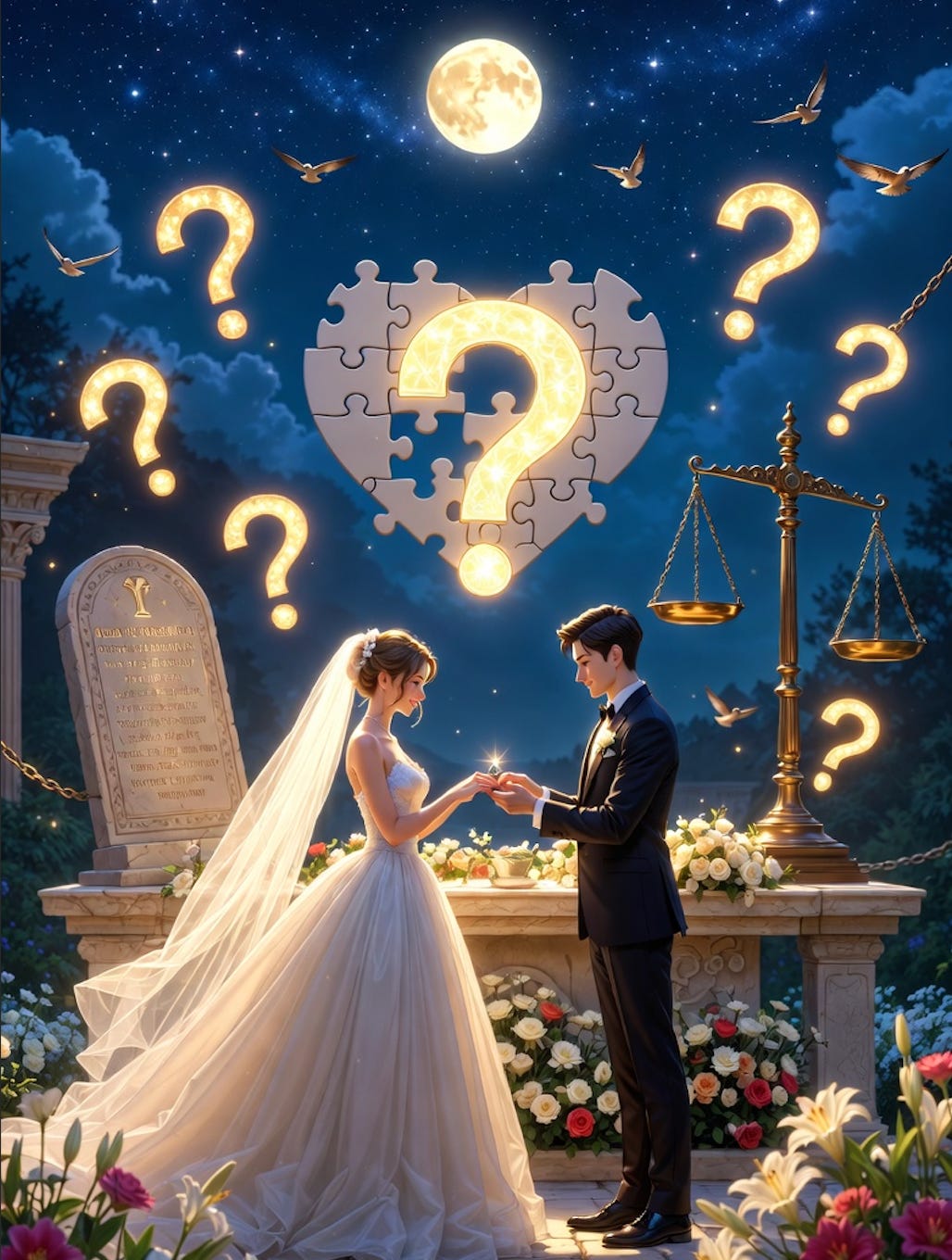
Before we go too far down the wedding aisle, it might be helpful to remind ourselves that what is often called “traditional” marriage is a curious, perplexing, and possibly even a bizarre institution.
Think about it this way: most men and women at a relatively young age will (often within a stone’s throw of puberty), amid countless members of the opposite sex from whom to choose, make a public vow to one person that they shall spend the rest of their lives together, loving and caring for each other exclusively. Two very different kinds of beings—the two great halves of humanity—are now united in a monogamous, sexually exclusive, and permanent relationship that is often fraught with mystery, uncertainty, adventure, joy, disappointment, longing, heartbreak, tedium, and peril.
How strange is that? Why limit yourself to just one person at such a young age? Why commit yourself forever? What’s the sense in that? And getting married is the easy part! It is the staying married part that’s hard.
The eighteenth-century Scottish philosopher David Hume actually thought marriage was an inherently “dangerous” enterprise, which is maybe why he never tied the knot. Consider what marriage does. “Nothing,” noted Hume, “is more dangerous than to unite two persons so closely in all their interests and concerns, as man and wife, without rendering the union entire and total. The least possibility of a separate interest must be the source of endless quarrels and suspicions. The wife, not secure of her establishment, will still be driving some separate end or project; and the husband’s selfishness, being accompanied with more power, may be still more dangerous.” Or, as House Minority Leader, Nancy Pelosi, once put it, “Why would you get married? Why would anybody get married?”
Pelosi’s question is not unreasonable, particularly given the divorce rate in the United States today, which stands at approximately forty-five percent. J. Paul Getty, one of America’s great twentieth-century industrialists and a man who was married five times, captured some of the mystery and irony that is marriage when he said, “I would gladly give all of my millions for just one lasting marital success.” Getty’s lament points to both the enduring desirability and difficulty of marriage, thus raising the question: is marriage rational?
Consider the moral meaning of that precise moment when a marriage is created. The publicly uttered wedding vows of a groom to his bride (reciprocated by the bride to her groom) typically go something like this:
“I, _Name_, take you, _N_, / to be my wife, / to have and to hold / from this day forward; / for better, for worse, / for richer, for poorer, / in sickness and in health, / to love and to cherish, / till death us do part.
With these forty-one words, the lives of two people change radically and forever. The decision of a man and a woman to marry is a life-altering moment in the lives of two different people, a choice that requires a good deal of wisdom about oneself and the other person—a very rare kind of wisdom, indeed.
But the fact that a man and a woman love each other above all others when they are 25 does not guarantee that they can or will love each other when they are 35, 55, or 75. Love is a complex thing. To be in love, which is to receive something, is not the same thing as to love, which is to give something. Marriage is a delicate balance between receiving and giving over a long period of time.
The practical challenge of marriage, however, is that individual men and women change over time; they change physically, psychologically, and emotionally, all of which means their needs and expectations change. Over the course of even just five or ten years, a wife may gain excessive weight and several chins, or a husband may go bald and develop a beer belly. One spouse becomes less attractive to the other or both to each other. With the inevitable physical changes that men and women experience will sometimes come psychological and emotional changes. One spouse may lose self-confidence whilst the other gains in self-confidence, and with those changes one partner becomes more or less interested in sexual relations with their spouse. Physical attraction changes over time. Rarely does it become stronger.
Often the material and spiritual values between married couples change as well, not to mention their moral, social, and political principles. What happens to a married couple where the husband becomes a radical vegan, and the wife becomes a devotee of the so-called “paleo” diet? What happens to a married couple when the husband wants to spend more and more money on cars and vacations and the wife wants to give more and more money to African charities? What happens when couples learn that they don’t share the same moral, social, and political values on topics such as welfare, abortion, drugs, sex, and pronouns? What happens if the wife is a Republican and the husband a Democrat? What if one becomes an atheist and the other is a devout Christian? What if one spouse supports transgenderism and the other doesn’t? And then, of course, there are the micro and macro differences that husbands and wives experience and face every day as they raise children.
If most people can’t know with certainty who or what they will become in the future, how can they expect to know who or what another human being will become 20 years in the future? And even if the particular individuals did not change one iota, the fact remains that relationships can and do change because our knowledge of the other person can never be absolute and because the relationship itself changes the people in it.
The romance and mystery with which marriage typically begins almost always ends in a very different place. At the beginning of marriage, husbands and wives may be described in their relationship to each other as “strangers in a strange land.” New love is a foreign place, and its mystery is exciting and dangerous. With time, however, marriage for many couples becomes familiar, dull, commonplace, and then, for all too many, it ends with crushing boredom and bitter resentment.
The biting sarcasm of H. L. Menken is not too far off the mark in describing the unromantic nature of many marriages. Speaking of husbands and wives in marriage, Mencken captured the enervating inertia of marriage: “By and by all the mystery of the relation is gone, and they stand in the unsexed position of brother and sister. Thus that ‘maximum of temptation’ of which Shaw speaks has within itself the seeds of its own decay. A husband begins by kissing a pretty girl, his wife; it is pleasant to have her so handy and so willing. He ends by making Machiavellian efforts to avoid kissing the every day sharer of his meals, books, bath towels, pocketbook, relatives, ambitions, secrets, malaises and business: a proceeding about as romantic as having his boots blacked. The thing is too horribly dismal for words.”
And of course, Mencken no doubt understood that the dismal art of marriage cuts two ways, not just one. I shudder to think what sharp-tongued female wits might say about their husbands. The Machiavellian lengths to which many women will go to avoid intimacy with their husbands is one of the principal causes of divorce. At the end of marriage, husbands and wives may once again be described in their relationship to each other as “strangers in a strange land” but for reasons entirely different than when they began their marriage.
On top of all the changes that define marriage, very few people get married in a vacuum. When a man marries a woman, he will almost always marry into her family. Brides typically come with mothers and fathers and brothers and sisters as well as an extended family of grandparents, aunts and uncles, cousins, nephews and nieces, and vice versa. Most grooms in addition to becoming husbands also become a son-in-law and a brother-in-law. Most people who marry, marry into an extended and complex web of family relations, each with its own history, challenges, and problems. Each one of these relationships has the potential to affect the relationship of husband and wife. Not a few marriages have crashed on the rocky shoals of in-laws.
With time, husbands and wives also typically become mothers and fathers to a child or several children, and then, together, they become seen as parents to the outside world. Babies change everything. What was knowable or predictable in the relationship between husbands and wives now becomes unknowable and unpredictable in their relationship as parents. Children often bring to the surface the sometimes differing values and principles of their parents that were left submerged or hidden before the birth of a child. Parents are required to rear and educate their children on everything from table manners and fashion to friendship and sexual morality. To expect husbands and wives to agree on virtually all the choices and actions they must take on behalf of their children is to expect what never was nor ever will be.
For better or worse, marriage is usually a package deal of multifaceted, multi-layered relationships, and these relationships can change who we are. Change, complexity, and confusion are therefore endemic to marriage. Some marriages get better over time, and some get worse. Tragically, then, many people experience marriage as a form of cruel and unusual punishment and, in the worst cases, as an emotional death sentence. Nietzsche tells us with some apparent truth “There is bitterness in the cup of even the best love.”
That men and women would commit themselves to marriage is therefore quite a remarkable thing. Human beings are fallible and they are not omniscient, and yet they make a decision that will affect them in the most comprehensive and profound ways for the rest of their lives. It turns out that forever—till death us do part—is a really long time. In today’s world, a marriage may last a good fifty, sixty, or even seventy years.
Living with the same person under the same roof day after day for years and then for decades almost always leads to marriages—including the very best—that experience periods of frustration, indifference, disillusionment, anger, pain, and resentment. Most marriages go through trials and tribulations that would wreck most other relationships. Friendships do not end in murder-suicides, for instance, but, tragically, some marriages do. Add children to the mix and the challenges of marriage are compounded in untold ways. It is an inherently fragile institution that has the potential to hurt and wound not only the married couple but also any children it may produce when it all goes wrong. The same is usually not true for friendships. This is why marriage is ultimately about more than just two people, and this is why we all have a vested interest in the nature and meaning of marriage as an institution.
In the light of all this, marriage is simultaneously the most curious—or bizarre—of all human institutions, and yet it is the most important, the most needed, the most beautiful, and possibly even the most natural of all human institutions.
So, let us go forward by asking two basic questions: What is marriage, and why do men and women need it?
Have a great day!
