
“Let us now praise famous men, and our fathers that begat us.”—Ecclesiasticus 44:1
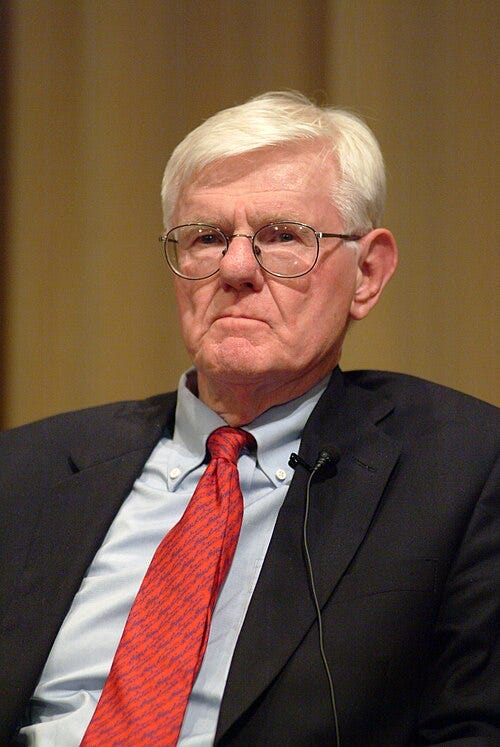
I’m deeply saddened—indeed, gutted—to learn about the tragic death of my dissertation advisor, Gordon S. Wood. Professor Wood was America’s greatest living scholar of the America’s revolutionary-founding period and quite possibly the greatest of all time. Even though he was 92, he was still as intellectually active as he was when I met first him 40 years ago. (I will link to a few of his interviews and lectures below.)
When I arrived at Brown University in 1986 to do my Ph.D., I was there for one reason only: to study with Professor Wood. He was already a giant in field. I wanted to study with the best, and he was the best.
Professor Wood’s first and most famous book was The Creation of the American Republic (1969), which revolutionized the study of the American founding. Creation forever changed the way historians and political theorists thought about the founding period. His second book, The Radicalism of the American Revolution (1991), was a stunningly original interpretation of the revolution and the ways in which it revolutionized American society. Many wonderful books followed, including a thoroughly charming biography of Benjamin Franklin (The Americanization of Benjamin Franklin), a massive reinterpretation of the politics of the 1790s (Empire of Liberty: A History of the Early Republic, 1789-1815), and an extraordinarily elegant dual biography of John Adams and Thomas Jefferson (Friends Divided: John Adams and Thomas Jefferson). And there were many other books.
I could say many things about my personal relationship with Professor Wood, but I shall limit myself to just two stories.
The first involves the writing of my dissertation. Shortly after I’d taken my Ph.D. General Exams, Professor Wood invited me to the Faculty Club to have lunch with him. At a certain point, he said to me: “Thompson, I know you’re not happy here. My advice is to move to Boston, write your dissertation, and send it to me when it’s done.”
That’s exactly what I did. Initially, I was not particularly happy with Professor Wood’s advice. It sure seemed as though I had been abandoned. By contrast, he typically worked relatively closely with most of his other graduate students, reading their dissertations chapter by chapter as they were being written and commenting on them.
During my time in Boston (Somerville to be exact), I worked in the bowels of Widener library at Harvard day and night for two years. During those two years, I never spoke to Professor Wood, not even once. When the dissertation was finished, I (snail) mailed him 600 pages, not a word of which he read until he received the rather large package in the post. Several weeks later, the phone in my flat rang. When I answered, the voice at the other end said, “Brad, it’s Gordon Wood. I’ve just read the first 200 pages of your dissertation and it’s brilliant! You don’t need to change anything!”
When we hung up, I was overjoyed, but I was also overwhelmed with a sense of guilt. What I knew but he didn’t was that the last quarter of the dissertation was a critique of him! He never called back to talk about the rest of the dissertation. That was probably for the best.
But here’s the point: by sending me to Boston, he did the very best thing that he ever could have done for me. He liberated me from his massive influence. Only later did I realize (and then he subsequently told me) that he banished me to Boston because he knew I didn’t need him to write my dissertation. He knew that I could do it on my own. Most importantly, what he really did was to set me free. During those two years in Boston, I developed a kind of intellectual independence that was—and has been—vitally important to my intellectual development. For better or worse, that dissertation was 100% me.
The second thing Professor Wood did for me was to share a piece of advice that I’ve never forgotten. He told me to “think big,” which is precisely what he did in his books. He advised me to write on grand topics—the topics that have scores if not hundreds of books written on them already (e.g., the American Revolution)—but to try and see and say things no one else has seen or said before. In both Creation and Radicalism, Professor Wood completely reconceptualized the way scholars saw and thought about the revolutionary-founding period.
Specifically, he advised me to not engage with other scholars in my books, at least not in the body of text. If you engage with other scholars that means, he said, that you’re letting them set the terms of debate, and, more importantly, it means that you don’t really have anything interesting or original to say. The key is to live with the primary sources and to search for new meaning in them.
He told me once that the key to being a great historian or political theorist was to look for and see the things that other scholars don’t see—to see the unseen. When I think about the meaning and importance of Professor Wood’s books, I’m reminded of what a European diplomat once said of John Adams: “He saw large subjects largely.”
In addition to the senseless tragedy of his untimely death, I’m particularly saddened by the fact that I will never get to have that “last talk” with him in which I was going to ask him all the questions that I’d been storing up for decades.
The truth is, he was supposed to come to Clemson on July 24 to participate in our John Adams Fellows Program. This new program is for graduate students from around the United States who work on the American founding. The plan was for me to have a semi-public conversation with him to be witnessed by a new generation of scholars about to launch their careers. Here a few of the questions I was going to ask him:
If you could write another book, what would you write on?
If you were to write a book on a topic other than early American history, what might you work on?
What are the great unexplored topics in early American history that you would advise graduate students today to work on?
What do you think is your greatest contribution to scholarship on the American revolutionary-founding period?
What are the best books on the American revolution and the American founding other than your own?
How is your work on the American founding similar to and different from the scholarship of political theorists (particularly the students of Leo Strauss) who work on the founding?
Who were the greatest historians of the American Revolution prior to World War II?
Which historians would you recommend as models of graceful writing?
Which scholars have most influenced your work?
What are the qualities and attributes that make a great historian?
What advice would you give to graduate students who might want to carry on your legacy?
Unfortunately, I’ll never get to ask these questions, and we’ll never know his answers to them.
Gordon S. Wood was a gentleman and a scholar of the highest order. We will never see the likes of him again.
May his memory be a blessing for all of us. R.I.P.
“Mourn not the dead, but rejoice in his life and example” - Charles Sumner
Thank you for sharing these stories of a great man. May his works and memory outlive us all.
Thanks for sharing those links. I'll look forward to reviewing them. Sorry for your loss, Brad.