
Ok, after a longish break, I’m back now to finish my series of essays on marriage. There will be at least three more essays to come.
The audio version of this essay is at the bottom.
“Naturam expellas furca, tamen usque recurret.” [“You may drive out Nature with a pitchfork, yet she still will hurry back.”]—Horace, Epistles Book I, epistle x, line 24.
Having defined and contrasted the metaphysical and postmodern views of marriage in previous essays in this series (see here and here), let us turn now and respond to the two most common and effective arguments for same-sex marriage, which are, first, that homosexuals deserve the same equal right to marry as do heterosexuals, and second, that same-sex marriage will have no effect on heterosexual marriage.
These two claims are meant to be irrefutable, conversation stoppers, but they are not. I shall demonstrate how and why both arguments are incoherent and collapse under their weightlessness. I shall take up the first argument (i.e., that homosexuals deserve the same equal right to marry as do heterosexuals) in this essay, and the second claim (i.e., that same-sex marriage will have no effect on heterosexual marriage) in the next essay in this ongoing series.
To take these two arguments seriously requires one to almost entirely evade the context defining the nature and meaning of marriage. The proponents of same-sex marriage do not want you to think about this issue on principle, nor do they want you to think about its long-term consequences. Instead, they prefer that you think about it in a narrow, superficial, emotionalist, concrete-bound, range-of-the-moment manner devoid of a larger context. They want to redefine marriage by substituting the secondary qualities and characteristics of marriage for the primary qualities and characteristics, which they consider to be irrelevant. This issue is much too serious and its consequences much too far-reaching to not examine it in the full light of day.
The question that we shall address is: should same-sex marriage be recognized as a moral and legal right?
MARRIAGE AND EQUAL RIGHTS
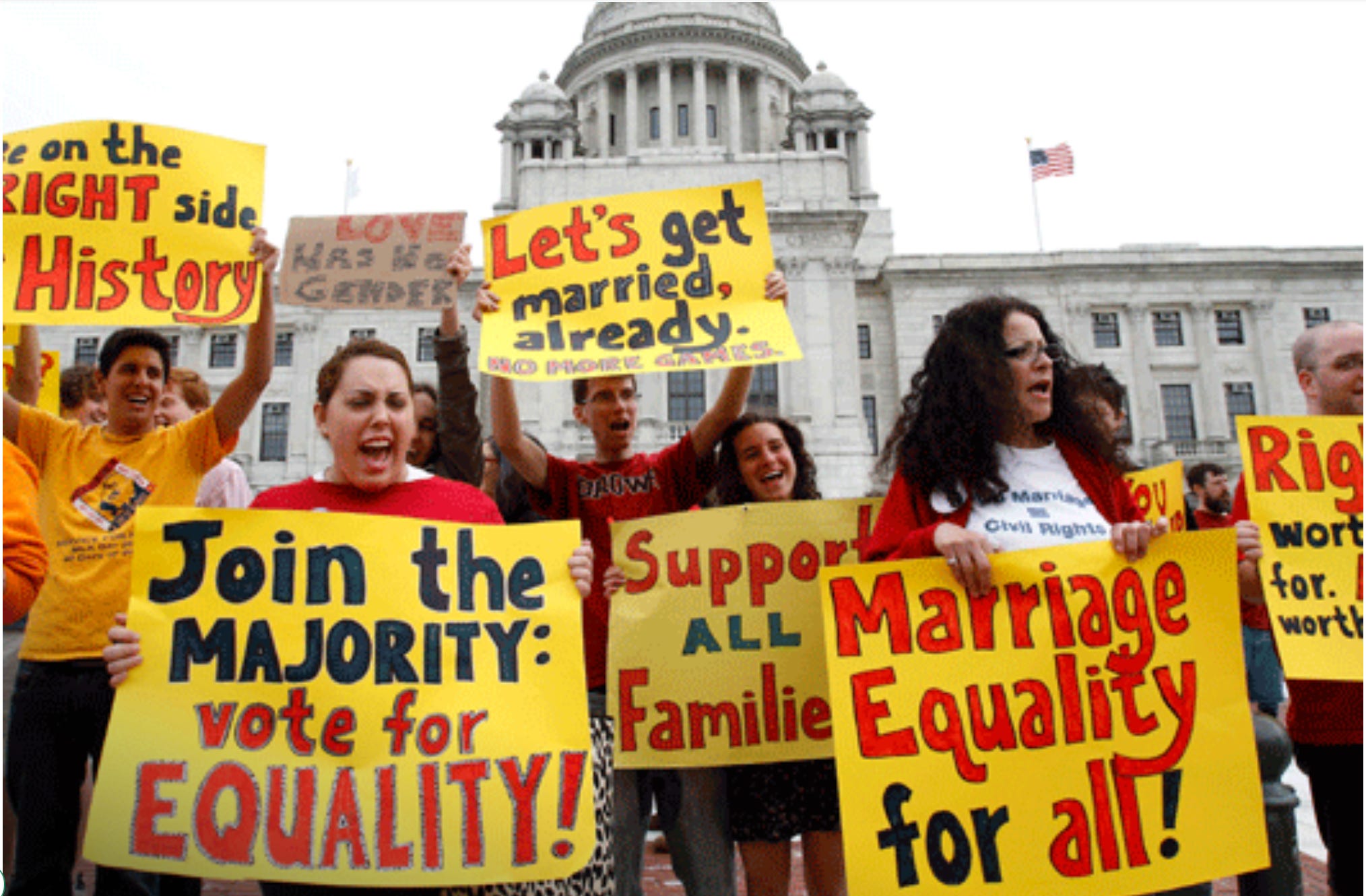
Over the course of the last two decades, the proponents of the same-sex marriage movement have successfully claimed the moral high ground in their fight for “social justice,” and they have certainly won the PR battle in the name of fairness and equality. Their cause is said to be the last frontier of the civil rights movement. (It turns out this “last frontier” was just the first of many new frontiers.) The same-sex marriage movement (and all other forms of postmodern marriage) speaks in the name of a catchy and near-irresistible slogan that fits conveniently on a bumper sticker: “marriage equality.” Who in America isn’t for marriage and equality? Who wouldn’t want the law to treat all marriages equally?
This was certainly the opinion reached by a federal judge in Texas, who declared a Texas law banning same-sex marriage unconstitutional on the grounds that: “Without a rational relation to a legitimate governmental purpose, state-imposed inequality can find no refuge in our United States Constitution.” Having claimed the mantle of rationality, equality, and the Constitution, the judge’s rhetorical legerdemain would seem to end any serious conversation on the topic.
Jonathan Rauch, one of the most thoughtful and influential proponents of same-sex marriage, reinforces the judge’s point this way in his influential book, Gay Marriage: Why It Is Good for Gays, Good for Straights, and Good for America :
‘All men are created equal,’ says the Declaration of Independence . . . ‘They are endowed by their Creator with certain unalienable rights . . . among these are life, liberty, and the pursuit of happiness.’ For homosexuals no less than heterosexuals, home and family . . . are at the heart of the pursuit of happiness . . . Marriage is an irreplaceable ingredient in the quest for home and family . . . and so, if the Declaration’s words mean anything, they suggest that to deprive millions of Americans of any hope of an emotionally satisfying relationship—marriage—is unjust. . . .
This is a rhetorically if not an emotionally powerful argument that touches on the fundamental values defining what it means to be an American. The proponents of same-sex marriage argue quite persuasively that to deny homosexuals “marriage equality” is a violation of their civil rights in the same way that requiring black Americans to sit at the back of the bus was a violation of their civil rights. Nay, more: the proponents of same-sex marriage have divined that their opponents are motivated by hatred, bigotry, and homophobia, which is akin to racism. To define and support marriage as the union of one man and one woman is now the moral equivalent of turning loose the dogs and hoses on homosexuals. To oppose same-sex marriage is therefore immoral because it means treating people unequally on the grounds of sexual orientation.
Jonathan Rauch is a serious and thoughtful man, but his claim is specious and fundamentally false. The simple truth is this: limiting marriage to one man and one woman does not violate anyone’s rights and it does not violate the principle of equality. It no more discriminates against homosexuals than does the government’s limiting of driver’s licenses to those who can see. Subjective wants and needs are not the same as reality and rights.
Equality in the tradition of the Declaration of Independence refers to the equal moral sovereignty of every individual in society. Equal moral sovereignty means equal individual rights. The principle of equality rightly understood does not mean equality of needs, demands, wants, choices, actions, relationships, lifestyles, and emotional states. Equality of rights does not mean equality of results; it does not mean giving everyone the same stuff; it does not mean giving all people access to the same government facilities; it does not mean that all relationships are equal; it does not mean sameness; and it does not mean that government must recognize all relationships as marriage.
State laws that recognize marriage as the union of one man and one woman do not use the coercive force of government to restrict or deny anyone’s freedom of action to associate or to form private contracts. In fact, if government got out of the marriage business altogether, recognizing and sanctioning no marriages, including heterosexual marriages, no one’s rights would have been violated.
If postmodern marriage were an inalienable right, on what possible grounds could the government deny bigamous, polygamous, or polyamorous marriages? On what “rational” grounds could our Texas judge deem a polyamorous marriage or the marriage between two heterosexual sisters to be deserving of unequal treatment before the law? If marriage were a right, why shouldn’t individuals have the right to marry as many people as they’d like or whomever they like? Surely such “state-imposed inequality” can find no place in the Constitution of the United States. Ironically, we will now allow two sixteen-year-old boys to marry (with parental and judicial consent) but not to vote! How can that be just?
How, then, can individual rights be violated in the context of marriage?
The rights of individuals (homosexual or heterosexual) would be violated if they were forced by the government to marry against their will, or, alternatively, if they were prevented from associating with whomever they wanted to associate with, including having sexual relations with whomever they wanted (standard exceptions apply, e.g., children and the mentally incompetent). Laws prohibiting homosexual relationships were—and are—a violation of rights and should be abolished.
The truth of the matter is this: There is no inalienable “right” to marry, not even for heterosexuals, if by a right to marry is meant the right to government recognition. (By way of analogy, there is no right to a driver’s license, which is why the government has the authority to restrict the kinds of people to whom it gives a driver’s license.) There is of course a fundamental right to free association that should extend to all adults to associate with whomever they choose. This right includes homosexuals and individuals in polygamous or polyamorous relationships, but there is no “right” for non-marital relationships to be recognized by government as marriages.
Morally decent people everywhere support marriage equality. All marriages before the law must in fact be treated equally. The philosophic error of the so-called “marriage equality” movement, however, is to put equality before or above marriage. They begin with a thoroughly egalitarian definition of equality and then apply it to marriage to get their preferred outcome. This is to define marriage by equality rather than by the facts of reality. It is putting the cart before the horse. Marriage equality must begin with marriage first (i.e., with an objective definition of marriage that is grounded in the facts of reality) and then apply the legal principle of equity or “equality before the law” to the concept of marriage. In other words, marriage reality (as established here) precedes and is the foundation of marriage equality. The facts, reality, and logic of marriage do not go the other way around. This is why defining marriage properly is the critical issue and must precede any discussion of marriage equality and the legality of marriage.
The simple truth of the matter is that there are no metaphysical facts which give rise to same-sex marriage. A proper rights-respecting government should have nothing to say about love or sex between consenting adults (heterosexual or homosexual). Government did not invent friendship and romantic love, nor should we ever want government to be in the business of defining or regulating friendship and romantic love. Such values and relationships would exist and thrive whether the government existed or not. They are entirely private matters. Marriage is, however, a different kind of relationship relative to all other relationships such as friendship or non-marital romantic love. It serves a different purpose. The difference between marriage and all other forms of romantic union is one of kind and not of degree, which means that the “privileges and immunities” and “equal protection” clauses of the Constitution’s Fourteenth Amendment simply don’t apply to non-marital relationships.
Marriage is and has been for millennia recognized by society and government as the union of one man and one woman for a specific purpose (i.e., the propagation, rearing, and education of children) and is therefore deserving of special consideration in the law. Moreover, men and women bring radically different qualities and characteristics (physical, intellectual, emotional, and spiritual) to a marriage, which, when combined, creates something wholly new and different and which serves to benefit children. Marriage reconciles two foreign worlds that are otherwise fraught with mystery, tension, insecurity, and danger in ways unknown to same-sex partnerships. This mixture creates a union that cannot be replicated in male-male or female-female relationships. The sexual union of a man and a woman has the potential to create new human life, while the sexual union of same-sex couples does not, and that is a fundamental difference of kind and not of degree. Moreover, a male-male relationship is different from a female-female relationship, and both are radically different from a male-female relationship, but the core or sole attribute of marriage is not the concept “relationship” nor is it simply defined by the male-female relationship. These other kinds of relationships are fundamentally different things. Each can be designated with its own category in civil law, but the “privileges and immunities” and “equal protection” clauses would only apply to and within each separate category.
Homosexual unions are self-evidently not the same as heterosexual marriages. They are different things that serve different ends. The former are about companionship; the latter are about family. To be clear: a same-sex union is something real, it is something unique, it is something important, and it is something that can and should be recognized in contract law, but it is not a marriage. It is something different and should be recognized by government as something different. Different things should be identified, named, and defined differently, and therefore treating different things differently does not violate any principle of equality or equity.
The moral norms, customs, and laws that support marriage are based on tens of thousands of years of human experience with the unique relations between men and women and the families they create. Applying the same norms, customs, and laws to relationships that do not involve a sex difference and its potential for creating new life is like applying the responsibilities of parenthood to those of same-sex friendship: both involve love and loyalty, but they are not the same kind of relationship with the same kind of rules or purposes. Traditional marriage laws do not discriminate against same-sex couples. They are laws and norms that refer to something specific in nature. Such laws have not, should not, and ultimately cannot recognize that which is not marriage without doing harm to what marriage is. Same-sex unions are a different kind of association that involve different kinds of behavior, and which pursue different ends. Hence, they are deserving of different kinds of laws that apply to different kinds of relationships.
Let us consider three more justice-related claims.
The first we might call the “reparations” argument or the Argument from Guilt, which says that because homosexuals have suffered past discrimination and various injustices, we should therefore give them what they want, which is marriage. Giving homosexuals the right to marry would be a form of social and legal reparations for past suffering. This is an argument that seeks to breathe without oxygen. Philosophically speaking, it can’t and shouldn’t be taken seriously by serious people, although it seems to be the underlying motive for many heterosexuals who support same-sex marriage. It is an argument motivated by an emotion (i.e., guilt), which easily and often turns into a passion (i.e., anger and resentment), the kind of passion that is willing to use State-sanctioned intimidation and violence to overcome historic injustice.
Acting because of guilt would, however, be a grave mistake. Guilt is not and should never be the foundation of justice. Our moral responsibility is to the living and to future generations, which means that we should do everything in our power to eliminate various injustices where they exist and to create and perpetuate a just and free society where we can. Our immediate moral and legal responsibility is to abolish laws that criminalize homosexual, polygamous, and polyamorous relationships. If such couplings and groupings want to establish themselves in permanent or semi-permanent social unions, we should eliminate from our legal system those laws that prohibit such relationships. Furthermore, we should also employ our common-law system to establish new laws that protect the rights of same-sex couples and polygamous and polyamorous groupings. That’s what justice in a free society requires.
A second justice-related claim says that same-sex couples are no different than childless heterosexual couples, which means to treat them differently is unjust. In other words, aren’t infertile couples, for instance, the exception that disproves the rule? Don’t they demonstrate the inconsistency, incoherence, and hypocrisy of the metaphysical view of marriage? If there are no meaningful differences between same-sex couples and infertile heterosexual couples on the metaphysical standard, would it not be an act of arbitrary injustice to exclude homosexuals from marriage? Once again, this faux challenge is a non-starter and easily answered.
The difference between the marital union of an infertile and a fertile heterosexual couple is one of degree only and not one of kind as when compared to a same-sex couple. First, the sexual union of a same-sex couple does not and cannot result in the creation of new life—ever! It is a biological impossibility, and the government knows this fact with absolute certainty, which is one important reason why government does not and should not have a stake in same-sex relationships. By contrast, government must assume that all heterosexual couples can produce offspring, whether they can or not and whether they want to or not. This is so for two reasons.
One, married couples unable to create children at one moment in time are often able to do so at a later period, particularly in today’s world with its remarkable advances in medical technologies and fertility treatments. Likewise, couples that choose not to have children when they first marry can later change their minds, and often do. Two, and more importantly, the government in a free society must never be in the fertility business. The proponents of a free society would not want, nor would they ever permit, the government to conduct background fertility checks of men and women who want to marry. What sane person would support the creation of a government department, agency, or bureau charged with determining the fertility of prospective marriageable couples? What sane person would support government intrusion into the most intimate details and private matters of their personal life and then have the “Federal Bureau of Marriage and Fertility Management” publicly label them as infertile and therefore not marriageable? Such government action would be both immoral and impractical.
Lastly, there are no negative externalities associated with recognizing the marriages of heterosexual couples who are infertile or who chose not to have children. Such marriages are benign; they do not have any negative effects on the institution of marriage; they do not undermine the principal characteristics of marriage (e.g., exclusivity, monogamy, and permanence), nor do they render mothers and fathers superfluous to childrearing. As we shall see momentarily, this is not true with same-sex marriages.
A third justice-related claim (closely related to the second) says that same-sex couples should have the right to adopt children just like heterosexual couples, and, furthermore, that same-sex couples can be just as loving as straight couples. And if homosexuals can adopt and if they can be loving parents, the argument goes, then why should they not be allowed to marry? If a same-sex couple can be parents and if there is “no difference” between same-sex and opposite-sex parenting, then haven’t they met the standard of marriage established by the metaphysical view? To deny homosexuals the right to be parents and to experience the life of parenting is unjust and motivated by homophobic animus. As with the other “justice” claims, this one is dismissed easily.
Let’s start with the obvious. Well, yes, of course, two men or two women can raise, educate, and love children under their care. This is true of heterosexuals and homosexuals. We know that spinsterly aunts and bachelor uncles, and various other heterosexual same-sex combinations, have successfully raised orphaned or abandoned children for eons. And of course, right now in America same-sex couples are successfully raising children. They provide them with a clean home, food on the table, and clothes on their backs. They provide them with love, affection, attention, and discipline. They change diapers, wipe noses, and kiss boo-boos. They drive their kids to soccer games, take them on beach vacations, read to them at night, and, as if to show the world how “normal” they are, they take them to Taylor Swift concerts. Same-sex couples even give their kids curfews, ground them, make them eat broccoli, and chaperone proms. They can do all these things just as well as anyone else. All that goes without saying. But that’s much too easy, and it misses the point.
The question is not whether a same-sex couple is capable or not of loving and raising a child. That is an evasion of a much more important issue. As with so much else in this debate, the real issue is not what is right or best for adults; the fundamental issue is what is best for children. The principal problem with the view that same-sex couples should have equal access to adopted children is that it is seen almost exclusively from an adult-centric perspective. It demonstrates a greater concern for the rights, wants, and feelings of adults than for those of children. It is less about the rights, wants, and needs of children and more about the psychological needs and social status of adults.
When viewed from a child’s perspective, however, the issue looks rather different. Again, the principal question is this: what is best for children?
Let’s examine this question by narrowing it through a series of corollary questions. All things being equal (e.g., family income, relationship stability, parental education, parenting ability, and, most importantly, the amount of love that two people can share with a child), is it better for the socio-psychological development of a child that he or she be raised by a mother and a father or a same-sex couple? Does it matter? Are children entitled to a mother and a father? Do they have a moral claim to speak of their parents as mom and dad? Do we cheat them of their birthright by consciously establishing a policy that may deny them their claim to a mother and a father? Is it an abuse of power for government officials to decide arbitrarily that one orphaned or abandoned child will have a mother and a father but another will have two dads? Do we abuse the most vulnerable and powerless children by depriving them of the experience of a mother and a father?
The current dispensation—the hipster pose—says that the needs and wants of children are irrelevant to the needs and wants of adults. Orphaned and abandoned children or mail-order children created in a petri dish are now to be objectified and treated as little more than created and sold commodities to satisfy the self-esteem needs of grown men and women. But surely children deserve more than to know that their mother was used by their two fathers as nothing more than temporary incubator or that their father was used by their two mothers as nothing more than a sperm-donor who masturbated into a glass jar for the price of an iPhone.
Children have a deep and profound longing and need for a mother and a father. They want to know where they come from and who created them. Their own self-understanding is developed by their experience with and knowledge of the two people with whom they share DNA. If they don’t have that experience and knowledge, they often have a sense of being lost and abandoned. Such children struggle to know who and what they are. Moreover, common sense and universal experience tell us that men and women, mothers and fathers, bring different virtues (and vices) to the task of parenting, and they satisfy the physical, intellectual, and emotional needs of children in different ways. Children require and deserve both. And if they can’t have their natural mother and father, surely it is no discrimination against the children to give them the next best thing: an adoptive mother and father. From a (natural or adoptive) mother and a father, they learn the different gender cues of men and women, and they learn how and how not to treat members of the opposite sex.
What common sense tells us social science confirms. All the social scientific evidence demonstrates clearly and persuasively that children do best when reared by their married biological mother and father. While it is certainly true that some children raised by same-sex couples turn out just fine, on average, children are much more likely to thrive throughout their lives if they are raised by a mom and a dad.
In those tragic situations where children are orphaned, we know that they want to be raised by a mother and a father. All of this can be put to the test quickly and easily. Ask an orphaned or abandoned twelve-year-old child if he would rather be adopted by a homosexual or a heterosexual couple. Ask an orphaned child if he or she would rather be adopted by Bob and Frank or Betty and James. Ask an orphaned child if he’d rather have two moms or a mom and a dad. I think we all know how orphaned children would answer. To not ask children these questions, to not care what they think and want, is to abandon them a second time. No child deserves to be abandoned even once; to be abandoned twice is unnecessarily cruel and unusual. Surely, we should be concerned about the dignity and self-worth of children.
Recognizing marriage as the union of a man and a woman does not therefore deny homosexuals the same basic civil rights accorded to heterosexuals. Governments for thousands of years have not extended this recognition to other kinds of loving relationships, but this was not a violation of rights. No rights have been violated because the government has not initiated physical force against anyone by not redefining marriage to include homosexuals. Governments properly recognize and thereby encourage and support marriage legally because it is an objectively good institution that benefits all people. In fact, marriage is the natural, pre-civil association that makes the principle of rights possible. Alternative romantic unions that seek perpetuity—e.g., polygamous, polyamorous, and homosexual—can and should be recognized and sanctioned by government as different but equal before the law. In other words, homosexual and other kinds of romantic unions can be recognized in law and their forms and formalities can mirror those of marriage, but they should not be recognized as marriage. They should be recognized for what they are, which is something uniquely different. Since homosexual unions bear no relationship to the procreative act, they are disconnected from the metaphysical roots of marriage. Homosexual love may imitate the manners and mores of heterosexual marriages—indeed, as Plato suggests, it may even transcend the love of the heterosexual union—but it cannot share in it.
Equal protection under the law does not mean making the same that which is different. There are existentially meaningful differences (i.e., differences of kind) between heterosexual and homosexual relationships (as I’m told there is between gay and lesbian relationships) that should be discovered, recognized, and respected in law. (The differences, however, between married heterosexual couples with and without children are of degree only.) Because homosexual unions are free from the fact of procreation and because they are built on the ever-changing emotional needs of two people, they cannot know or experience the psychological, moral, and cultural norms that have grown up around true marital unions, which are rooted in the generative act. Without that anchor, same-sex unions are plastic and malleable and therefore don’t require the same moral norms to sustain them. The primary characteristics of marriage (e.g., monogamy, sexual exclusivity, and permanence)—characteristics that are necessary for the survival and wellbeing of marriage—have no fixed metaphysical connection to same-sex relationships and are therefore not necessarily needed for same-sex unions.
It is both reasonable and just to sustain a legal distinction between marriage as heterosexual and all other forms of partnership both heterosexual and homosexual. To demand that homosexual unions be treated as no different from, and equally necessary to society as heterosexual unions—to demand that homosexual unions be guaranteed all of the experiences available to heterosexual unions—to demand that homosexual unions be guaranteed the same kinds of experiences that result from heterosexual procreation, is non-objective, irrational, unjust, illiberal, and, in the end, tyrannical.
The only violation of rights in the current marriage debate comes from those who would use the coercive force of the government to redefine marriage to be something that it is not. As I shall demonstrate in later essays in this series, those who support “marriage equality” are willing to violate the rights of innocent individuals so that their whims and need for recognition are satisfied. In the end, “marriage equality” is not really about equality, equal rights, or “equal protection”; it is about identity politics and the use of political force to celebrate that identity.
Audio recording:
Have a great week!!!
Two distinctly different aspects of life yield an interesting illustration.
I’ve been fascinated with the vegetarian obsession with creating foods that taste just like or even look like meat. If you’ve rejected eating an entire category of edible commodity, why are you driven to simulate eating it?
We were exposed to published photos of an unsuccessful candidate for president outfitted in a harness of sorts enabling him to simulate breast feeding an infant he and his partner (wife?, husband?) had adopted.
Both of these simulations are unspoken recognition that one has willfully chosen to defy the natural order of things and resorted to imitating that which has been rejected.
As a Christian the origins of this are clear to me and illustrate the human capacity to refuse their created order and simulate it by imagined artifice. We are all cursed with our own knowledge of good and evil. Our creator provides the way to follow His definition but unredeemed mankind persists in coming up with their own definitions. Tofu steak and strap on bottles are silly substitutes for reality.