
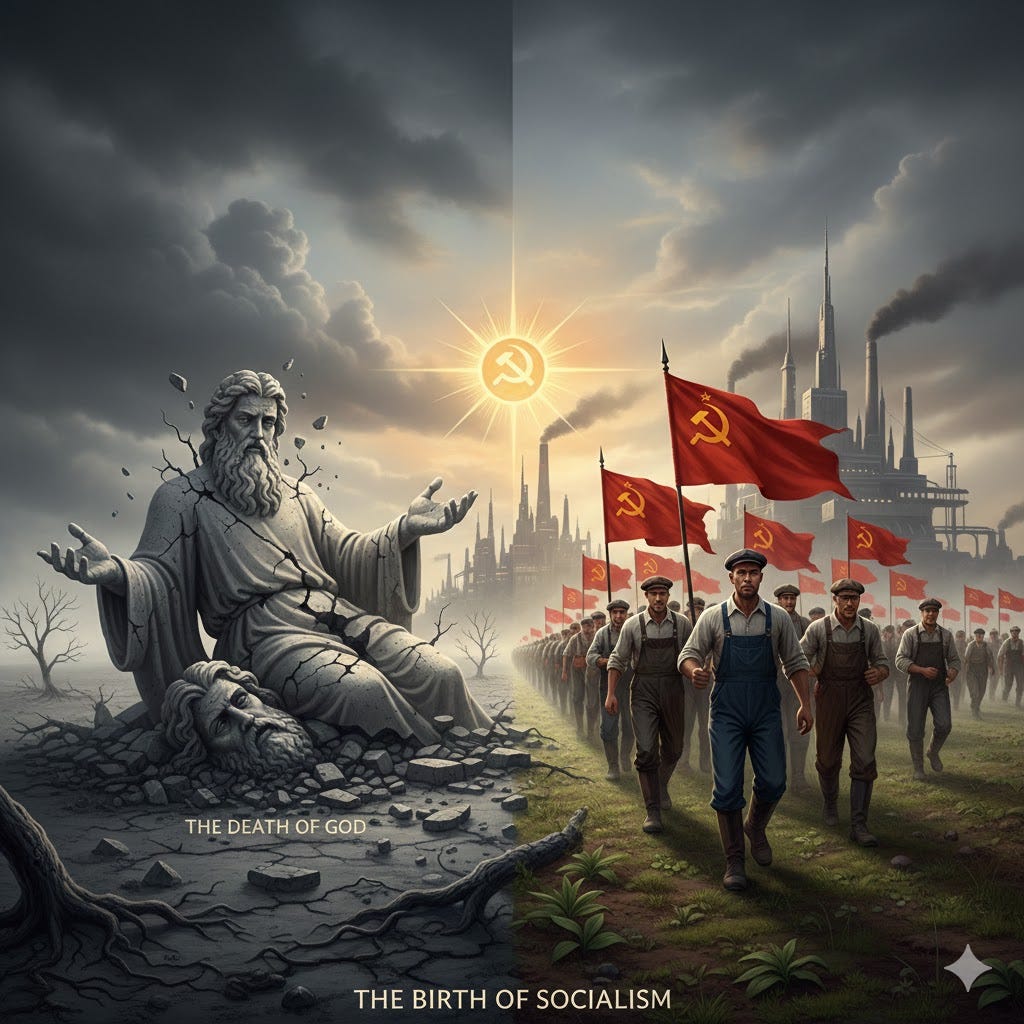
***The audio file for this essay (at the bottom) is for paid subscribers only.
“I believe that Karl Marx could have subscribed to the Sermon on the Mount. . . . I believe that it is possible for Christians to be Marxists as well and to work together with Marxist communists to transform the world.”—Fidel Castro, Fidel and Religion
“Christianity is the grandmother of Bolshevism.”—Oswald Spengler, The Hour of Decision
In my last essay in this series, “Communism as Christian Heresy,” I examined the connections and parallels between communism and Christianity. I there described communism as a “Christian heresy” and as “Christianity in a hurry.” Still, we are left with lingering doubts. Indeed, for many, the very thought of a connection between Christianity and communism seems impossible if not absurd. Still, there is a nagging problem: we don’t quite know why and how so many Christians have become socialists or communists over the decades, which is an undeniable fact. It’s also worthing noting that the rise of welfare-state liberalism, socialism, and communism in the West seems inextricably if not eerily connected to those nations most indebted to Christian beliefs. These facts must be understood and accounted for.
My task in this essay is to explain—or at least to begin to explain—the inexplicable. To that end, I shall explore two related questions: Is there something in Christianity that naturally leads Christians to socialism and communism? Conversely, is there something in socialism and Marxian communism that attracts Christian men and women?
Before we tackle these questions, though, let us get a sense of the broader historical and philosophic context in which these conversions have taken place. To repeat: we want to know why and how so many men and women in the West have either transitioned from Christianity to communism, or who have retained their devotion to Christianity but nevertheless support socialist policies.
“GOD IS DEAD” AND THE RISE OF COMMUNISM
The rise of communism overlaps and runs parallel with the decline of Christianity in the West. Christianity began its decline—a decline in the belief that Christianity is true and a slow decline in church membership—in the middle decades of the nineteenth century (though it had been under assault philosophically by Enlightenment thinkers for some 200 years), which is precisely when Marxian communism was born. The theory and practice of communism seemed to fill an intellectual, spiritual, and moral void in the souls of men. It provided them with a new reason to live and hope, and a new form of redemption and salvation in a world in which the Christian faith was losing its hold over the minds and souls of men.
The Christian soul, and with it the soul of the West for over 1,500 years, believed God was the creator of the universe (Genesis 1:1), the creator of light (Genesis 1:3), the creator of “every thing beautiful” (Ecclesiastes 3:11), and the creator of all this is good (Genesis 1:4,10,12,18,21,25). The Prophet Isaiah stated clearly and powerfully the Christian view of God as the father of all creation:
Have ye not known? have ye not heard? hath it not been told you from the beginning? have ye not understood from the foundations of the earth? It is he that sitteth upon the circle of the earth, and the inhabitants thereof are as grasshoppers; that stretcheth out the heavens as a curtain, and spreadeth them out as a tent to dwell in: That bringeth the princes to nothing; he maketh the judges of the earth as vanity. . . . Lift up your eyes on high, and behold who hath created these things, that bringeth out their host by number: he calleth them all by names by the greatness of his might, for that he is strong in power; not one faileth (Isaiah 40: 21-26).
The Christian God was the creator, and He was also a legislator, a judge, and an executor for all things human. He was all knowing and all seeing. The Christian God was a loving and just God, but He was also a jealous, powerful, judgmental, vengeful, and sometimes angry God, who gave men commandments by which to live their lives, and when they didn’t he punished them. The Prophet Nahum tells the people of Judah that their God is a jealous, all-powerful, and vengeful God, who is the sovereign judge over their lives.
God is jealous, and the LORD revengeth; the LORD revengeth, and is furious; the LORD will take vengeance on his adversaries, and he reserveth wrath for his enemies. The LORD is slow to anger, and great in power, and will not at all acquit the wicked: the LORD hath his way in the whirlwind and in the storm, and the clouds are the dust of his feet. He rebuketh the sea, and maketh it dry, and drieth up all the rivers: Bashan languisheth, and Carmel, and the flower of Lebanon languisheth. The mountains quake at him, and the hills melt, and the earth is burned at his presence, yea, the world, and all that dwell therein (1:2-5).
For those who did not follow His commandments, destruction and damnation hung over their heads as the Sword of Damocles. Within this moral framework, the Christian knew right from wrong and the moral boundaries of his earthly life. The Book of Deuteronomy makes clear how God will treat sinners: “To me belongeth vengeance and recompence; their foot shall slide in due time: for the day of their calamity is at hand, and the things that shall come upon them make haste” (32:35).
Christianity provided Occidental man with a moral path and compass by which to live his life. It was inconceivable to the Western mind for almost two millennia that it could live without God’s commandments and sanctions, without moral markers to point the way forward.
But what happens when God calls, and no one hears? Conversely, what happens when men call on God, and he does not answer? What happens when men have no foundation on to distinguish between good and evil?
This is precisely what happened to Western man starting in the second half of the nineteenth century. Not since God asked of Eve, “What is this that thou hast done?” (Genesis 3:13), not since God said, “Behold, the man is become as one of us, to know good and evil” (Genesis 3:22), not since Moses “said unto God, Who am I” (Exodus 3:11), and not since Solomon confronted the apparent meaninglessness of human life in the face of death (Ecclesiastes 3:19-21) had Western man faced such a profound crisis of meaning.
This existential crisis—a nightmare of nightmares—was both summed up and initiated by Friedrich Nietzsche in the shattering 1882 pronouncement of his madman:
‘I seek God! I seek God!’ . . . ‘Whither is God?’ he cried; ‘I will tell you. We have killed him—you and I. All of us are his murderers. But how did we do this? . . . What were we doing when we unchained this earth from its sun? . . . Whither are we moving? . . . Are we not straying as through an infinite nothing? Has it not become colder? Is not night continually closing in on us? Do we not need to light lanterns in the morning? Do we hear nothing as yet of the noise of the gravediggers who are burying God? Do we smell nothing as yet of the divine composition? Gods, too, decompose. God is Dead. God remains dead. And we have killed him.’
Nietzsche was the forensic pathologist of Western culture. The point of his having declared God dead was first to simply announce the fact (to bear witness), then to determine the cause of death, and finally to prognosticate the future consequences of God’s death for Western civilization. To be clear: he was not applauding God’s death. When he says that God is dead what he means is that the belief in the idea of God is declining fast and hard.
Why is that, and who is the “we” in “we have killed him”? For Nietzsche, the philosophic age known as the Enlightenment (with its scientific rationalism and relentless philosophic critique of all irrationalism) murdered the possibility of God. The belief in God was rendered untenable for thinking Europeans.
For Nietzsche, the death of God was a catastrophic moment for Western civilization. For two millennia the Christian God had been the “sun” around which European and American cultures had revolved, but now humanity was unchained from the gravitational force of its life-giving source. In particular, the belief in the Christian God provided men with purpose and meaning in their lives. And without this belief, men and women were left to drift in an infinite, cold, dark, and meaningless void. With this one earth-shattering pronouncement, the entire moral framework of Western civilization imploded.
The death of God ushered in the birth of nihilism, which represents the death of the moral world order. In the Preface to the Will to Power (1887-1888), Nietzsche claims that his book presents the “history of the next two centuries,” which is “the advent of nihilism.” Nietzsche’s nihilism says that there is no truth, no value, no beauty, no goodness, and, ultimately, no meaning to life. Pure or radical nihilism is, Nietzsche wrote, “the conviction of an absolute untenability of existence when it comes to the highest values.” The highest or most perfect form of nihilism requires not just the transvaluation of all value but the destruction of all values. The Christian God gave man moral boundaries and a reason and purpose to live, but without God everything—everything that had once been considered morally taboo—becomes permissible and sometimes even celebrated.
The death (or murder) of God shatters any connection between men and their Maker, and with that rupture, men must return to that time and place before God gave light, which of course means there was no “In the beginning.” Man returns to the “infinite nothing,” to that cold place and time where all is darkness and chaos. This means that man’s situation is worse—much worse—than after the time when Adam and Eve were expelled from the Garden of Eden. And there is no return to God through Christ, and there is no possibility of man’s rediscovering the Tree of Life as prophesied in the Book of Revelation (22:2). Jesus’s “good tidings” have turned to dust. There is no possibility of a Kingdom of God and, without that promise, man has no incentive to be good.
Worse: the death of God puts man beyond all good and evil. Thus, the belief in a transcendent moral truth collapsed, and the dizzying vertigo of nihilism left Western man disoriented and on his hands and knees.
Starting in the nineteenth century, European Christians no longer faced the struggle between good and evil because there was neither. As Nietzsche put it in Twilight of the Idols (1889):
They are rid of the Christian God and now believe all the more firmly that they must cling to Christian morality. . . . When one gives up the Christian faith, one pulls the right to Christian morality out from under one’s feet. . . . Christianity is a system, a whole view of things thought out together. By breaking one main concept out of it, the faith in God, one breaks the whole: nothing necessary remains in one’s hands. . . . Christian morality is a command; its origin is transcendent; it is beyond all criticism, all right to criticism; it has truth only if God is the truth—it stands and falls with faith in God.
And with the death of God came the death of Christian morality. In the wake of Nietzsche’s declaration, nothing could or would be the same again. As Nietzsche put it in The Gay Science (1882), “The greatest recent event—that ‘God is dead,’ that the belief in the Christian god has become unbelievable—is already beginning to cast its first shadows over Europe.” Nietzsche’s dramatic and dire announcement left European man unmoored in stormy seas without a moral rudder to guide him. God, Christ, the Gospels, and the Church had provided men with moral boundaries, guidance, and inspiration for almost eighteen-hundred years.
But what happens to men whose lives are now unprotected and left to fortune? What happens when all promise, all future hope, and all expectation come to an end with God’s death?
The receding tide of Christianity and its soul-wrenching effects on European man were expressed brilliantly by Matthew Arnold in his poem, “Dover Beach” (1867). Without the light of Christ’s gospel and “good tidings,” what was left for men to guide and uplift their spirits?
But now I only hear
Its melancholy, long, withdrawing roar,
Retreating, to the breath
Of the night-wind, down the vast edges drear
And naked shingles of the world. Ah, love, let us be true
To one another! for the world, which seems
To lie before us like a land of dreams,
So various, so beautiful, so new,
Hath really neither joy, nor love, nor light,
Nor certitude, nor peace, nor help for pain;
And we are here as on a darkling plain
Swept with confused alarms of struggle and flight,
Where ignorant armies clash by night.
The existential crisis first announced by Nietzsche’s prophecy left men without direction, purpose, and meaning in their lives. The nineteenth century launched for Western man a crisis of meaning. All was now darkness.
Almost 80 years later, as the crisis deepened, W. H. Auden captured the psychological and moral malaise that slowly engulfed men and women starting sometime in the middle of the nineteenth century, and which crashed like a cultural Tsunami in the early twentieth century. In his poem, “The Age of Anxiety,” Auden expressed the existential burdens and the sense of doom experienced by men without the guiding hand of their Christian God:
Storm invades . . .
To the waiting sea, where the weary find rest,
Where the lost are found, where the lonely are loved,
Where the heart is healed in the haven of peace.
Here we halt, here we hope to dwell,
In the quiet kingdom of the quelled passions,
In the gentle garden of generous deeds.
But the path is perilous, the passage unsure,
And the map is missing for the maze we must tread.
Who will guide us, who will guard our going,
Through the dark defiles, the dangerous turns?
Only the One, the Original,
The Maker of mountains, the Mover of stars,
The Shaper of shadows, the Shifter of sands,
He who holds in His hand the heart of the world,
He who knows the need of the nameless and lost,
He who sees the sparrow and spares it its fall,
He who builds the bridge and binds the broken,
He who calms the chaos and calls us His own,
Our colossal father.
But “Our colossal father” is dead announced Nietzsche’s madman. The message was clear: he’s not coming home, and he can’t save us. Man is alone, and his burden is one of fear and trembling.
After the metaphorical death of God, Western man had two paths forward. One path led toward Nietzsche’s Zarathustra, and the other path led toward Marx’s communist man (who is Nietzsche’s “Last Man”). The Nietzschean path leads to a secular resurrection of a new God in the form of Zarathustra and a new Jesus in the form of the Übermensch, and the Marxian path leads to the secular resurrection of a new God in the form of History and the dialectic and a new Jesus in the form of Marx himself. (I may one day examine the Nietzschean path, but our concern today is with the Marxian path.)
THUS SPOKE MARX
With the death of God, socialism in its many nineteenth-century forms emerged as the most potent and promising of these new temporal faiths. Marxian socialism offered a comprehensive secular replacement for the shattered Christian cosmology and eschatology.
As we saw in “Communism as Christian Heresy,” Marx replaced the transcendent Christian God with “History,” which he presented as a purposeful, directional, and dialectical force moving inexorably toward a final, redemptive goal. This new religion had its own savior (Marx), its own holy scriptures (the collected works of Marx), its own disciples and prophets (Engels, Lenin, Trotsky, etc.), its own chosen people (the Proletariat), its own church (the Bolshevik Party or Comintern), its own Book of Revelation with its promise of a final judgment (the Manifesto of the Communist Party), and its own promise of a Kingdom of Heaven in the form of a Kingdom of Freedom where all suffering is forever abolished (see The German Ideology). Marxism provided the masses (but in truth only the priestly class of so-called “intellectuals”) who were adrift in a meaningless universe, with an all-encompassing moral narrative that explained everything—past, present, and future. The socialist vision gave meaning and hope to the poor and suffering.
Karl Marx’s self-presentation was that of a secular Savior, who gave men, particularly those who were poor and destitute, a cause—a final cause full of cosmic significance. Marx’s stirring words gave men a reason to live, to hope, and to fight: “A spectre is haunting Europe—the spectre of Communism. All the Powers of old Europe have entered into a holy alliance to exorcise this spectre. . . . The communists everywhere support every revolutionary movement against the existing social and political order of things. . . . . Let the ruling classes tremble at a Communistic revolution. The proletarians have nothing to lose but their chains. They have a world to win. Working men of all countries, unite!”
Suddenly, men—particularly the so-called intellectuals—had a new reason to live (and die if necessary) and a new faith to which they could attach their deepest longings and allegiances. The words of Marx and Engels remind one of Paul’s letters to the Ephesians in which he implored them to “Put on the whole armour of God, that ye may be able to stand against wiles of the devil. For we wrestle not against flesh and blood, but against principalities, against powers, against the rulers of the darkness of this world, against spiritual wickedness in high places. Wherefore take unto you the whole armour of God, that ye may be able to withstand in the evil day, and having done all, to stand (Ephesians 6:11-13).” Communism and Christianity have both been massive forces in the world precisely because they appeal to man’s sense of righteousness and cosmic justice.
But what exactly is this sense of righteousness and cosmic justice? What is its deepest source? Where does it come from? To what passion or longing in the human soul do socialism and communism appeal?
Despite the massive differences between communism and Christianity, they do share and are motivated by—even if only subconsciously—three fundamental passions: 1) envy, which translates into contempt for the rich and all differentiating wealth; 2) guilt, which translates into empathy for the poor and downtrodden; and 3) autophobia, which translates into love for the universal brotherhood of mankind. Communism and Christianity are therefore driven by a combined and powerful emotional impulse to punish the wealthy, to help the needy, and to unite with others as their primary moral motives. Starting in the mid-nineteenth century, some Christians transferred their passions and their faith to a new cause to achieve the moral ends of their old faith.
Both the communist and the Christian begin with a similar moral passion for a certain kind of justice that almost always sides with the poor and weak against the wealthy and powerful in the name of humanity. This tripartite gospel of deliverance appeals to the poor and dispossessed, and it appeals most often to the children of privilege who seek absolution from guilt and participation in a righteous cause above and beyond themselves. Communism and Christianity promise different kinds of salvation, but they are both forms of redemption within shouting distance of each other.
The socialist ethic is a direct continuation of Jesus’s championing of the “poor,” the “exploited,” the “oppressed,” and the “downtrodden,” whose condition becomes the standard of moral and political righteousness. It furthermore treats the successful, the wealthy, and the powerful—as did both the Bible’s Old and New Testaments—as an inherently evil and exploitative class. The socialist ethic, borrowing from the Christian ethic condemns selfishness or self-interest as a cardinal vice and selflessness or self-sacrifice as a cardinal virtue.
THE BIRTH OF TRAGEDY
For most nineteenth-, twentieth-, and now twenty-first century socialists and communists, the deepest source of their passion for “social” justice and redemption originated in their childhood experiences with Christian ethics. So it was for Fidel Castro, for instance, who once said that during those years when he was leaving formal Christianity and becoming a communist, he retained the ethics of Jesus that he learned as a boy, and therefore he always sided with the poor against the wealthy. Castro’s transition from the ethics of Jesus to the ethics of Marx was relatively easy, simple, and seamless. The morality of his revolutionary socialist outlook was formed originally as a boy from his deeply Christian mother, grandmother, and aunts, and then from his schoolteachers, all of whom grounded young Fidel in the moral teachings of Jesus.
From Jesus, Comandante Castro claimed to have been formed by three core Christian teachings: 1) to hate the rich and powerful for their alleged injustices, humiliations, and abuses against the poor and weak; 2) to love the poor and weak for their poverty, weakness, and helplessness; and 3) to admire and reward the selfless martyrdom of those who sacrifice their selfish interests for the sake of others.
To achieve these Christian ends, Castro, now the Marxist-Leninist revolutionary, developed and then implemented a strategy for deep social change that involved educating Christians to become communists, which he did by teaching the poor, weak, and trembling that the ethics of Marx were those of Jesus. He spoke the language of Jesus to the downtrodden to gently and subtly move them to support the communist movement and join the political struggle.
Castro, more than most communist leaders, spent a great deal of time meeting and working with Catholic Bishops in Cuba, the United States, and in the rest of Latin America to relieve the suffering of the poor and downtrodden. The Cuban Marxist-Leninist told the US Bishops, for instance, that the ethics of Jesus he was taught as a boy were at the heart of his understanding of communism and that the only meaningful differences between Christianity and communism were those of means and methods. Castro believed, he said, that Marxist-Leninists had developed the idea of Christian love “to its highest point and that a communist society will develop it still more,” and that “it is possible for Christians to be Marxists as well and to work together with Marxist communists to transform the world.”
Buried deep in the secular sub-conscious of many Western socialists and communists is a pang of their inherited Judeo-Christian conscience—that is, their Christian love and Jewish guilt. The Jewish concept “Tikkun Olam,” for instance, which means “repairing the world,” and Christ’s admonition to his followers at Matthew 25:31-46, emphasize the individual’s ethical responsibility for “social” justice, which can lead to guilt when individuals feel they have not done enough to improve the world or live up to their Jewish or Christian moral standards.
Likewise, the Christian who is tempted by or ultimately converts to communism is no doubt succored by Mary’s song of praise to her newborn son: “He hath put down the mighty from their seats, and exalted them of low degree. He hath filled the hungry with good things; and the rich he hath sent empty away.” (Luke 1:52-53). At the end of volume one of Capital, Marx gives the Christian convert to communism a teaching to mirror Mary’s Magnificat, where “History” replaces the “He” as the agent of justice and social change. As with Mary, Marx is describing the final, apocalyptic climax of the capitalist system, a moment of revolutionary reversal that directly mirrors the language of the Magnificat:
Along with the constantly diminishing number of the magnates of capital, who usurp and monopolise all advantages of this process of transformation, grows the mass of misery, oppression, slavery, degradation, exploitation; but with this too grows the revolt of the working-class, a class always increasing in numbers, and disciplined, united, organised by the very mechanism of the process of capitalist production itself. The monopoly of capital becomes a fetter upon the mode of production, which has sprung up and flourished along with, and under it. Centralisation of the means of production and socialisation of labour at last reach a point where they become incompatible with their capitalist integument. This integument is burst asunder. The knell of capitalist private property sounds. The expropriators are expropriated.
The means employed by communism and Christianity are different, but their ends are similar. Communism is the only systematic doctrine in the modern world that has been able to translate the moral impulse of Christianity into a secular faith of hope and redemption. In the words of Catholic theologian, José Porfirio Miranda (1924-2001), “for a Christian to claim to be an anti-communist . . . constitutes the greatest scandal of our century.” Why a scandal? Because, in Miranda’s words, “it is Christianity that started communism.” The fact of the matter is that from the first century A.D. to the twenty-first, many Christians have been devout (mostly non-Marxian) socialists of one kind or another. Indeed, in their words, they only want to see the gospel become reality. Communism was founded, they claim, with and by Christianity. Christian communists typically reject the materialism and atheism of Marxian communism, but they believe that the moral ideal of communism is called for in The Bible as the proper and necessary way in which to organize one’s communal life. In sum, according to Miranda, “the Bible teaches communism” and “communism is obligatory for Christians.”
I leave you, my friends, with one question: how shall the non-communist, non-socialist, non-Progressive, non-liberal, non-woke Christian respond to Miranda’s claims?
Everything depends upon your answer!
Have a great week!
The audio file of this essay is for paid subscribers only.
