
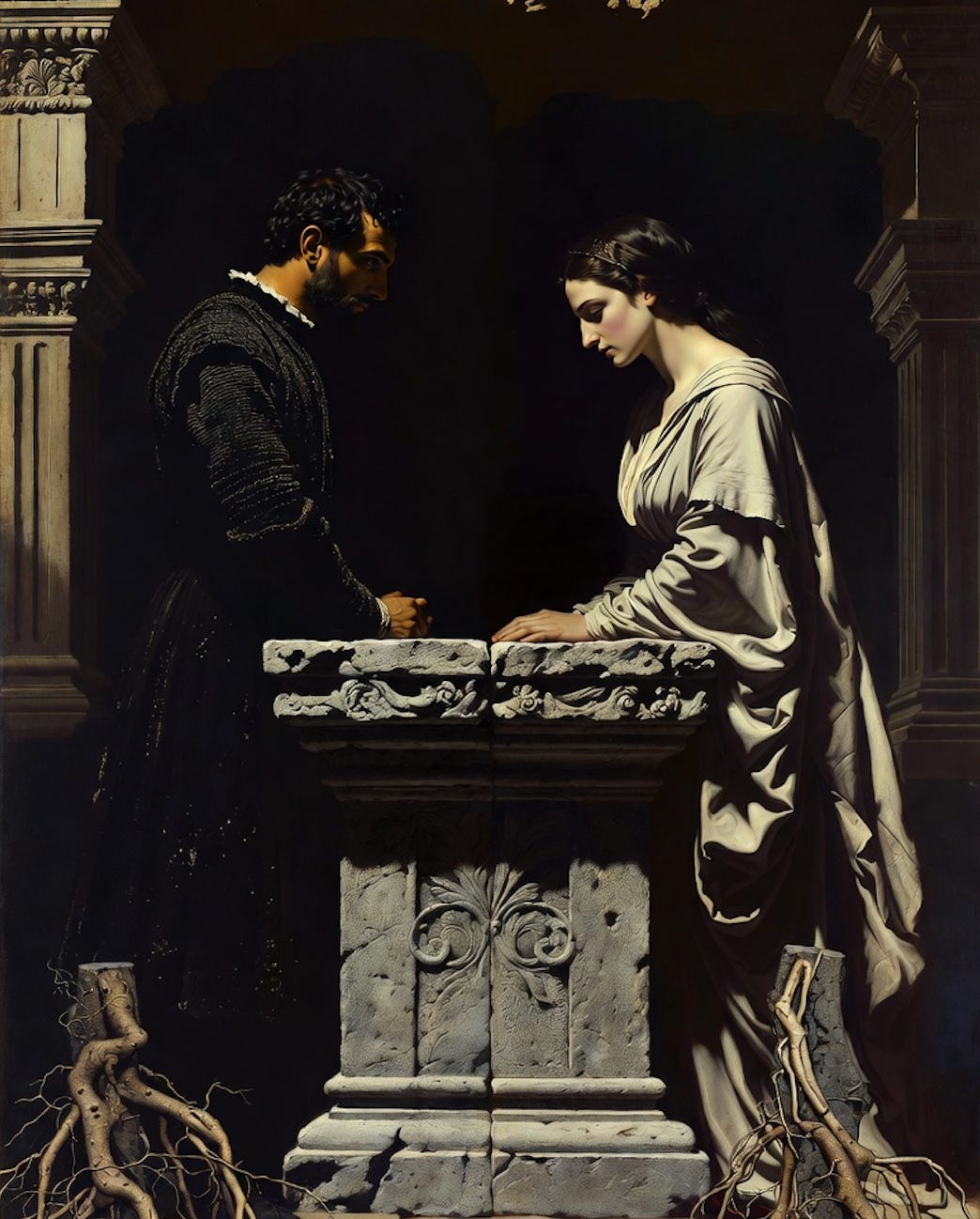
***This is the first essay in a series on the nature, purposes, meaning, and consequences of marriage. I can think of no topic more important than that of marriage. The series will last as long as I’ve said what I need to say.
I have no doubt that both religious conservatives and secular Progressives will find things to dislike throughout the series. That’s ok. Please feel free to leave comments in support of or against my claims. If you disagree, prove me wrong and make a better argument. I’m open to persuasion.
This first essay is merely introductory, while succeeding essays will drill down more deeply into the marriage question.
The audio recording of this essay is available at the bottom.
“It is a good thing when a man and woman choose to live together as husband and wife. It is a joy to their friends, a warning to their enemies, but only they know the true meaning of it.”—Homer, The Odyssey
The Western world is experiencing an unprecedented change in how it views the nature and meaning of marriage. Fewer people today are getting married, and almost forty-five percent of those who do end their marriage in divorce. More importantly, the Supreme Court of the United States ruled 5-4 in its 2013 landmark decision, U.S. v. Windsor, that certain provisions of the 1996 federal Defense of Marriage Act were unconstitutional, thereby opening the door to nationalizing same-sex marriage (SSM), which of course is precisely what happened two years later in the Supreme Court’s Obergefell vs. Hodges decision.
The Court’s 5-4 decision in Obergefell ruled that the 14th Amendment’s Due Process and Equal Protection Clauses require all states to license marriages between two people of the same sex and to recognize same-sex marriages lawfully performed in other states. Justice Anthony Kennedy’s majority opinion held that the fundamental right to marry is inherent in individual liberty and applies equally to same-sex couples, as there is no fundamental difference between same-sex and opposite-sex unions with respect to the principles of love and companionship. In a nanosecond, an almost 5,000-year-old, legally-recognized institution was changed radically.
The Windsor and Obergefell decisions represent a major event in the life of the nation not dissimilar to the 1857 Dred Scott decision. (I am not suggesting that these two very different institutions are the same morally.) Chief Justice Taney’s opinion in that infamous case expanded the meaning of property to include slaves, thereby laying the groundwork for the nationalization of slavery. Similarly, Kennedy’s opinion in Obergefell expanded the definition of marriage to include same-sex unions, thereby nationalizing same-sex marriage. In both cases, the majority opinions were subject to powerful dissents, which in turn reflected the views of a divided public. All parties to the Windsor and Obergefell cases recognize that the court’s two-pronged decision goes to the heart of our society’s most fundamental values and principles.
Regardless of what the Supreme Court says or what the cultural consensus is at any given moment, serious philosophic questions about monumental questions never go away. And few questions are more important than the question of marriage. In fact, I’m not sure that I can think of a more fundamental and consequential moral question. Consider, for instance, one of the critical functions served by a wedding, which is to encourage those in attendance and witnessing the union to reflect upon the nature, meaning, and beauty of marriage.
Still, as a culture, a nation, and even as a civilization, I do not think that we reflect often or deeply enough about the nature and meaning of marriage. Certainly the older I get and the longer married I am, the more I feel drawn to think about marriage. It took a long time (maybe longer than it should have), but I think I’m only just now beginning to see the monumental importance of marriage not just for my life but for civilization.
How, then, should we view marriage in the twenty-first century? Have we transcended the traditional and outdated understanding of marriage and reached some bold new and higher meaning of marriage?
The New World of Marriage
For several thousand years of human history, the idea of same-sex marriage had less reality than the idea of unicorns. It was simply beyond the pale of what wise men and women in every culture considered in accord with the nature and purposes of marriage. In the blink of an eye, all that changed. A moral and cultural Tsunami—one that is sweeping aside customary social norms and legal precedents that have existed for millennia—is now washing over America with breathtaking speed.
Both sides of the marriage issue understand that altering the institution of marriage will have profound consequences for the kind of society we live in. This Brave New World will affect the kinds of relationships we have as adults, and it will certainly affect how we understand the nature of the family and the raising of children. To discuss the nature of marriage is therefore to discuss the nature of the family, which in turn is to discuss the nature of society.
To fully appreciate the intellectual, psychological, cultural, and political revolution that has taken place in the last quarter century, let’s consider some basic historical and sociological facts. Up through the late 1990s, only a handful of obscure intellectuals were even talking about same-sex marriage. Even by the early 2000s, the idea of same-sex marriage was incomprehensible for most Americans. As late as 2008, Barack Obama and Hillary Clinton both publicly opposed same-sex marriage. Today, that view is equated with Jim Crow segregation.
Even more remarkably, this massive cultural upheaval has taken place with virtually no serious public discussion, no serious intellectual engagement, and no serious thought about the profound effects it will have on our individual and cultural self-understanding. How do we account for this enormous sea change in public opinion over the course of the last twenty years or so?
This much is certain: the proponents of same-sex marriage were enormously successful in raising vast sums of money to advance their cause culturally and politically, methodically relentless in their grassroots organization and marketing, tireless in pushing their message through the print and electronic media, Hollywood and the music industry, and utterly ruthless in propagandizing the universities and America’s schools K-12. In short, we’ve witnessed nothing less than an intellectual blitzkrieg, a program of cultural “Shock and Awe” over the course of the last two decades that has left many dazed and confused.
And so, what seemed unthinkable within the memory of most adults is now a legal and cultural fact. Ask a typical college student today if he or she supports same-sex marriage and the answer is an incredulous “well, of course.” It is a complete non-issue for many of today’s young people. It is not a subject about which they must do any heavy mental lifting. The justice of “marriage equality” is a truth self-evident to Millennials and Gen Z requiring no reasoned defense. In fact, to even question the propriety or wisdom of same-sex marriage is now beyond the pale of civil discourse or social decency. Young people feel no real need to think seriously and deeply about the profound effects that redefining marriage will have for our self-understanding, and they seem disinterested in reflecting upon the far-reaching practical implications that same-sex marriage will have for our society.
We now live in a curious world where otherwise relatively uneducated and thoughtless teenagers and twenty-somethings have reached a new stage of post-Hegelian enlightenment, a state of higher consciousness unavailable to their reactionary and unenlightened parents and teachers, who are now thought to be out of step with the times. Publicly announcing one’s opposition to same-sex marriage on an American college campus today is almost akin to announcing that one is a Christian or an atheist on a street corner in Mecca. Observing the disdainful and hectoring attitudes of our young people today reminds one of the child revolutionaries in Roland Joffé’s 1984 film The Killing Fields, who lecture their much wiser elders in reeducation camps on the historical inevitability of The Revolution.
How did America’s young people, who seem to know so little about anything else, come to have such enlightenment? What is the source of this newfound wisdom? It would seem that the long arc of History has already declared as predestined tomorrow’s winner and losers. Who needs Xenophon, Socrates, Plato, Aristotle, Plutarch, or Locke on marriage when you have “Will and Grace” and the “Modern Family” (aka the TV shows) on your side?
America’s rapidly changing demographics on the marriage question do not, however, tell the whole story. More ominously, American society today is now divided between the enlightened few and the unenlightened many. On one side stands reason, morality, freedom, equality, progress, compassion, decency, and love, and on the other side stands nothing but the forces of superstitious irrationalism, reactionary stupidity, Troglodytish bigotry, and segregationist oppression. To support the institution of marriage as the union of one man and one woman is now seen by many as illiberal, which means bad. It is the Forces of Light set against the Forces of Darkness. This Manichean world is now divided into binary categories of Us and Them, Friends and Enemies, Saints and Sinners, Believers and Infidels, all of which can be reduced to “The Good” and “The Evil.” The unwashed masses that stand for traditional marriage are said to suffer from a new kind of mental illness: homophobia.
Not surprisingly, many conservatives and libertarians have either waved the white flag of surrender, or they have begun calling for a brokered truce on the marriage issue before any real intellectual engagement has taken place. But a truce was never an option for the proponents of same-sex marriage. Nary a shot was fired in the cultural battle over same-sex marriage before the Nervous Nellies of the Right vacated the intellectual battlefield and began their fast retreat. This would suggest that they quickly realized they had been wrong on the marriage issue, that they are intellectual cowards, or compromising pragmatists.
Thus, it was only a matter of time before Ross Douthat, the lone “conservative” columnist at The New York Times and a supporter of traditional marriage, waved the white flag asking in a whimpering op-ed for “The Terms of Our Surrender.” Douthat conceded unconditional defeat on the marriage issue and expressed his hope that the conquering forces would treat him and his friends humanely.
Make no mistake about it: this is a cultural revolution the likes of which has never been seen before.
Still, for the tens of millions of unenlightened Americans stuck in the here-and-now, the question of marriage is a living and not a settled issue. It is not going away anytime soon. In fact, we may very well be witnessing the beginning and not the end of the marriage debate. Thoughtful Americans on both sides of the issue are right to wonder about the true meaning and long-term consequences of redefining marriage politically. The form in which this conversation takes place will be a test of who we are as a nation.
We do well, then, to recall Abraham Lincoln’s prescient words as he contemplated the impending crisis haunting the United States in the late 1850s: “If we could first know where we are, and whither we are tending,” he said, “we could then better judge what to do, and how to do it.” These are wise words for our present discontents. It is imperative that we understand “where we are, and whither we are tending” on the marriage question. Thoughtful Americans will no doubt disagree with one another on this controversial topic, which is why we must demand nothing less than a rational, serious, frank, and high-minded conversation. While it is still permissible to think and talk about the nature and meaning of marriage and family, let us do so in the spirit of genuine philosophic investigation.
To that end, I plan to offer a (longish) series of essays on three general topics: 1) the nature and meaning of marriage; 2) the role played by marriage in society; and, 3) the relationship between marriage and government in a free society. I will publish several essays under each of these broad topics.
The first general area examines two competing theories of marriage: what I call the metaphysical and the postmodern. These essays ask the following questions. What is the origin, purpose, and structure of marriage? Is it grounded in objective reality, or is it an infinitely flexible social construction? If it is grounded in objective reality, what are the facts that give rise to it? If it is a social construction, can its purposes and characteristics be remade at will?
The second general area examines the two best arguments for same-sex marriage: first, that homosexuals deserve the same right to marry as do heterosexuals; and second, that same-sex marriages will not diminish opposite-sex marriages.
The third general area examined in this series investigates the relationship between marriage and government in a free society. More particularly, I shall ask two questions: first, what is the proper role of government in marriage, and second, will laws supporting same-sex marriage expand or contract government and the sphere of freedom in America?
In the end, all of us should examine, philosophically, the nature and meaning of marriage and its relationship to the principles and practices of a free society. We must examine the presuppositions of the metaphysical and postmodern views of marriage and then explore the practical implications and consequences of both views. The manner in which we define marriage will have real consequences for how we think about the structure and wellbeing of families, how we think about the nature and meaning of motherhood and fatherhood, and, most importantly, it will affect how we think about the rearing and education of children. Surely these are topics worthy of the deepest philosophic consideration.
Ultimately, the way we view marriage will profoundly affect how we view the kind of society we are and want to be. In many ways, the marriage question, philosophically understood, cuts to the core of the human condition. To ask what marriage is, or should be, is one of the most important and fundamental human questions. It speaks to who and what we are as humans.
The time has come for Americans to renew their interest in the marriage question. As we go forward, let us pursue the truth about marriage in the spirit of rigorous and honest analysis.
I look forward to this series of essays, Dr. Thompson! I had several questions as I read, but it looks the three general areas you will examine should answer those questions. One question/thought I had was why does marriage need a political definition beyond the fact that it is a contract between consenting adults? Isn't marriage a matter of individual rights and leaving people alone to live their lives as they choose?
I have no particular objection to SSM nor interest in advocating for it but it never should have been imposed by judicial fiat. The court system is completely out of control on many more issues than this. You were much too kind to Chief Justice Taney. Had he stuck to the issues being litigated, the case would not be so infamous. Slavery is immoral but it was enshrined in the Constitution at the time and the Fugitive Slave Act was covered by the interstate commerce clause. However, he went beyond the substance, in ex parte conspiracy with the President, to declare that free blacks couldn't be citizens because then we would have to let them have guns. And then he declared the Nebraska Compromise to be unconstitutional. This was an accelerant to regional tension soon to lead to Civil War One. Or Two as some of your earlier writing argued.